What’s the difference between Email Hosting and Google Workspace?
Email hosting and Google Workspace (formerly known as G Suite) are both services that allow businesses and individuals to manage their email accounts, but there are key differences between the two:

- Email Hosting:
- Email hosting refers to the provision of email servers and services by a hosting provider, allowing users to create and manage custom email addresses associated with their own domain names (e.g., yourname@yourdomain.com).
- With email hosting, users typically have access to basic email features such as sending and receiving emails, managing contacts, organizing emails into folders, and setting up email forwarding and autoresponders.
- Email hosting services may vary in terms of storage limits, mailbox size, security features (e.g., spam filtering, antivirus protection), and administrative controls.
- Email hosting providers may offer additional features such as webmail access (accessing emails via a web browser), IMAP and POP3 support for email clients, and integration with third-party applications.
- Google Workspace:
- Google Workspace is a cloud-based suite of productivity and collaboration tools offered by Google. While it includes email hosting as one of its core services, it also includes a range of other productivity tools such as Google Drive (for cloud storage), Google Docs, Sheets, and Slides (for document editing and collaboration), Google Calendar, Google Meet (for video conferencing), and more.
- With Google Workspace, users get access to professional email addresses (e.g., yourname@yourdomain.com) hosted on Gmail, along with advanced email features such as custom email routing rules, advanced spam filtering, email encryption, and integrated chat and video conferencing.
- In addition to email, it provides a suite of collaboration tools that enable teams to work together in real-time, share documents, schedule meetings, and communicate effectively.
- Google Workspace offers seamless integration with other Google services and third-party applications, providing a unified platform for productivity and collaboration needs.
- Google Workspace is available in different subscription plans with varying levels of features and storage limits, catering to the needs of individuals, small businesses, and large enterprises.
In summary, while both email hosting and it provide email services, it offers a more comprehensive suite of productivity and collaboration tools beyond email, making it suitable for businesses and organizations looking for a unified solution for communication and collaboration. Email hosting, on the other hand, focuses primarily on providing email services and may offer a simpler and more cost-effective solution for users who only need basic email functionality.
Let’s explore the pros and cons of both email hosting and Google Workspace:
Email Hosting:
Pros:
- Custom Domain: Email hosting allows you to use your own domain name for email addresses, giving your emails a professional appearance (e.g., yourname@yourdomain.com).
- Cost-Effective: Email hosting plans can be more budget-friendly, especially for individuals or small businesses with basic email needs.
- Flexibility: You have more flexibility in choosing your email hosting provider and can select a provider that meets your specific requirements and preferences.
- Privacy and Control: With email hosting, you have full control over your email data and can ensure that it remains private and secure.
- Compatibility: Email hosting services typically support a wide range of email clients and devices, allowing you to access your emails from desktop, webmail, and mobile applications.
Cons:
- Limited Features: Basic email hosting plans may lack advanced features such as collaboration tools, advanced spam filtering, and integrated productivity apps.
- Support: Support options may vary depending on the email hosting provider, and you may not have access to the same level of support and resources available with larger providers like Google.
- Scalability: Email hosting plans may have limitations in terms of storage space, mailbox size, and the number of email accounts included, which could be a limitation as your business grows.
- Integration: Integration with other productivity tools and services may be limited compared to comprehensive suites like Google Workspace.

Google Workspace:
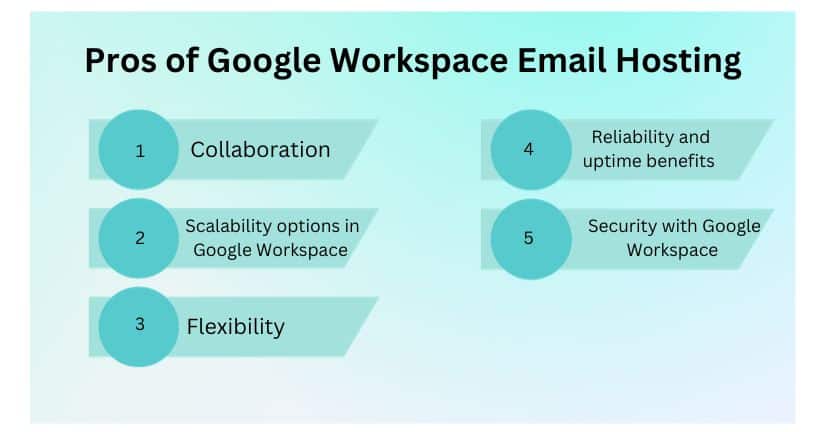
Pros:
- Comprehensive Suite: Google Workspace offers a comprehensive suite of productivity and collaboration tools beyond email, including document editing, cloud storage, video conferencing, and more.
- Integration: Google Workspace provides seamless integration with other Google services and third-party applications, offering a unified platform for communication and collaboration.
- Advanced Features: Google Workspace includes advanced email features such as custom routing rules, advanced spam filtering, email encryption, and integrated chat and video conferencing.
- Scalability: Google Workspace plans are scalable and can accommodate the needs of individuals, small businesses, and large enterprises, with flexible storage options and user management features.
- Reliability and Security: Google Workspace offers reliable email hosting with high uptime and robust security features, including built-in spam and malware protection, encryption, and two-factor authentication.
Cons:
- Cost: Google Workspace plans can be more expensive compared to basic email hosting plans, especially for businesses with a large number of users or those requiring advanced features.
- Dependency on Google: Using Google Workspace means relying on Google’s infrastructure and services, which may be a concern for some users in terms of data privacy and vendor lock-in.
- Learning Curve: While Google Workspace offers a wide range of features, some users may find the learning curve steep, especially if they are not familiar with Google’s ecosystem or cloud-based tools.
- Customization Limitations: While Google Workspace offers extensive features, customization options may be limited compared to self-hosted email solutions or other providers that offer more flexibility in customization.
In summary, the choice between email hosting and Google Workspace depends on your specific needs, budget, and preferences. Email hosting may be suitable for those looking for a cost-effective solution with basic email functionality, while Google Workspace offers a comprehensive suite of productivity and collaboration tools ideal for businesses and organizations looking for an all-in-one solution.
